
Agentic AI in legal services: adding client value?

By Aisling O'Connell | 2 July 2026 | 7-minute read
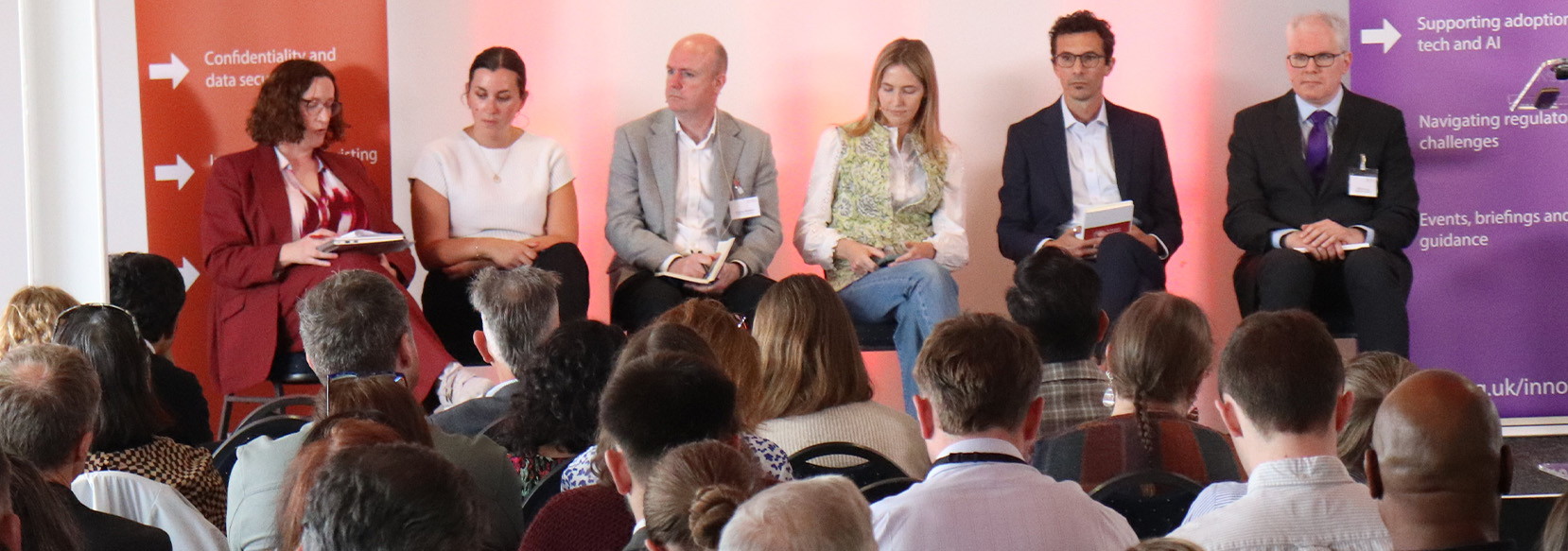
Speakers at our most recent SRA Innovate event discussed how agentic AI could reshape legal workflows and improve client experience, but it also creates new risks that must be managed.
An effective agentic AI system can be like an orchestra playing together, observed Olivier Roth, a Policy Manager in the SRA's Innovation Policy team, at last month's SRA Innovate Event in Bristol.
At these free annual events we bring together experts from across lawtech and legal services to share knowledge on the latest technological developments, provide practical insights and create opportunities for discussion and networking across the sector.
Throughout a morning of engaging discussions – that covered topics as varied as AI governance and how AI-assisted coding, often known as vibe coding, can open it up to non-experts – agentic AI was a topic that came up again and again.
What is agentic AI?
Our keynote speaker Lisa McClory, Of Counsel, DeepTech and Innovation, at CMS, described an agentic AI system as one that chains tasks together using a central AI agent that coordinates activities and separate specialist AI agents that carry out specific tasks.
The idea being that these AI agents can manage multi-stage tasks or processes, rather than needing separate instructions after every step is completed.
Alexandra Lennox, Head of New Propositions at real estate AI platform, Orbital, contrasted a basic AI chatbot with a more sophisticated agentic AI system. Where the chatbot is comparable to a 'student that can answer questions posed by a lecturer', an agentic AI system can make a plan and then deliver on writing an essay, (and upload it to the right place). She was speaking in the 'what's on the horizon?' panel discussion, which focused on emerging AI technologies.
Embedding AI agents into operations can create more efficient workflows, leading to a better client experience, the panellists suggested.
Philip Young, Co-Founder and CEO of Garfield AI, the first AI-driven law firm to be authorised by the SRA, also highlighted how AI systems can enable legal services to be offered far more flexibly. For instance, at Garfield, a litigation assistant platform that aids businesses to recover unpaid debts of up to £10,000, they have observed many people are using the platform outside of business hours. With many of their users accessing the platform late at night or in the early hours of the morning.
Start with client needs
A consistent piece of advice offered by our speakers, to any solicitor or law firm thinking about embedding agentic AI into their workflows, was to start with a good understanding of client needs.
'Engage with clients first and put clients at the heart of what you're building', counsels McClory. She added: 'don't proceed on assumptions, plan around a solid understanding and validate your ideas. Otherwise, there is a risk of creating obsolete technology.'
Thomas Maddern, a Partner at KPMG UK stressed the importance of understanding business processes in detail. Start by thinking through core functions and capabilities, and which of those could be delivered without human intervention, he suggested. In addition, consider what clients want and need from these processes, and where your firm can add value, he said.
Firms should expect client expectations to continue increasing as they 'have access to this technology themselves' says Amy Conroy, Senior Engagement Manager at Legora, an AI workspace designed for legal professionals.
Strong AI governance is essential
The risks associated with AI use such as the potential for data misuse and inaccurate information generation, through hallucinations, are well-known. Given that agentic systems are completing more complex tasks, and with lower levels of direct oversight, than earlier AI models the risks are arguably even higher.
For that reason, McClory says it is crucial that firms have effective governance in place, that is regularly reviewed as models develop. While requirements will depend on the specific context, she suggested general considerations such as ensuring there is a person with accountability and they have sufficient information, such as data logs, to perform that role effectively.
In a world where AI is playing a greater role in legal work, she also emphasised that human lawyers 'need to be more human than ever'. It will become increasingly important for them to focus on areas like strategic thinking and relationship skills, she said.
The SRA's regulatory approach is outcomes-focused. We expect those we regulate to exercise their professional judgement on issues such as AI risk management, with reference to our principles and code of conduct. The use of AI does not transfer responsibility: authorised individuals remain accountable for legal services and must ensure AI-generated outputs are appropriately reviewed and supervised.
We want to do more to support responsible AI adoption, so we are developing public-facing resources to help firms and solicitors understand how the use of AI fits within our existing rules and regulations.
Read more about the SRA's work on AI and other technologies in the Innovate section of our website.
Author profile
Aisling O'Connell
Head of Innovation Policy
Aisling O'Connell is Head of Innovation Policy at the SRA.
Prior to joining the SRA, Aisling worked as the Technology and Innovation Policy Lead at the Legal Services Board, the oversight regulator for legal services in England and Wales.
She has also worked on complex projects as part of the HMCTS Reform programme and as part of the Implementation Unit in the Ministry of Justice.